
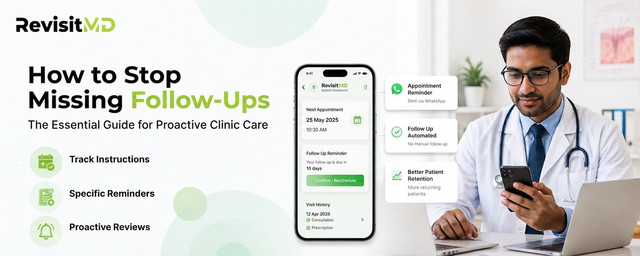
Bridging the Gap: Why Missed Follow-Ups Happen and How to Fix Them
A missed follow-up is different from a missed appointment. There is often no booking to miss in the first place.
The doctor says, “Come back in three weeks” or “Get this test done and share the report,” and then nothing formally tracks whether that happened.
For a patient with a straightforward case, that gap may be a minor inconvenience. For someone managing a chronic condition, recovering from a procedure, or waiting on an investigation, it can mean a problem goes unnoticed for months.
Reducing missed follow-ups does not usually require a complicated system. It requires treating “come back in three weeks” as a task with an owner, rather than a passing comment.
Why Follow-Ups Get Missed More Than Appointments
1. Lack of Structure
A booked appointment has structure around it. A slot exists, reminders are sent, and someone notices if the patient does not show up.
A recommended follow-up often has none of this.
It may be said verbally at the end of a consultation, written on a prescription pad, or mentioned casually during the visit. From there, it depends entirely on the patient remembering or someone manually tracking it.
2. Resource Constraints
In a solo or two-doctor clinic, there is rarely a person whose only responsibility is tracking follow-ups.
The receptionist is busy handling today’s patients while the doctor moves on to the next consultation. Follow-up tracking can easily become a secondary task that gets pushed aside.
3. The Assumption Trap
The instruction to return quietly becomes the patient’s responsibility.
Patients forget, get busy, postpone the visit, or assume that if it were important, the clinic would have called them.
The Patients Where This Matters Most
Not every missed follow-up carries the same weight. Certain patient groups need closer attention.
| Patient Category | Why It Matters | Risk of Missing |
| Chronic Conditions | Long-term acne treatment, PCOS management, or ongoing orthodontic care depend on a consistent rhythm of visits. | A missed visit can turn into a long gap with no natural trigger to bring the patient back. |
| Post-Procedure Checks | Early complications are often easier to identify and treat when caught early. | Patients may not realise that something needs attention until it becomes more serious. |
| Pending Investigations | Blood tests, scans, and biopsies often happen outside the clinic and require the patient to bring the results back. | Results can easily get lost in the process if no follow-up is formally created. |
What Actually Reduces Missed Follow-Ups
1. Turn Instructions Into Tasks
The moment a doctor recommends a return visit or investigation, record it against the patient with a due date, just like an appointment.
“Come back in three weeks” should become a trackable task.
2. Send Specific Reminders
Replace generic messages such as “Please visit the clinic” with targeted reminders.
For example:
“Your follow-up for the treatment you started on 5 August is due.”
Specific reminders give patients context and make the action clearer.
3. Use Multi-Touch Outreach
A single reminder is a starting point, not a complete follow-up system.
Patients who ignore the first message may need a second reminder with different wording or, when appropriate, a short phone call.
4. Isolate Pending Investigations
Treat pending test results as their own category.
Instead of grouping them with general appointments, create a specific reminder such as:
“Please share your test results with the clinic.”
This makes it easier for staff to identify what is still outstanding.
5. Review Missed Follow-Ups Periodically
A short weekly review of patients who were due for follow-up but did not return can help staff proactively reach out before too much time passes.
Where This Fits Into the Bigger Picture
Missed follow-ups are part of a broader patient-retention challenge.
When care depends entirely on staff memory, things can eventually fall through the cracks, no matter how good the team’s intentions are.
This is the specific gap RevisitMD is built around: keeping what was recommended during each visit connected to automated reminders and follow-ups.
Instead of discovering that a patient missed their follow-up months later, RevisitMD can help make that missed action visible when it happens.
Frequently Asked Questions
Is a missed follow-up the same as a no-show?
Not quite.
A no-show is a missed booked appointment. A missed follow-up is often a recommendation that was never formally scheduled in the first place. That is part of why it is easier to lose track of.
Which patients need the closest follow-up tracking?
Chronic-care patients, patients recovering from procedures, and patients waiting on test results generally need closer attention.
A gap in follow-up for these patients can affect the actual care outcome, not just the clinic’s schedule.
Does this require a lot of extra staff time?
Not necessarily.
If the recommendation is tracked when it is made and reminders are automated, the manual workload can be significantly reduced.
The bigger time commitment often comes from trying to recover missed follow-ups after the patient has already drifted away.
How often should a clinic review patients who missed a follow-up?
For most solo or small clinics, a short weekly review can be a practical starting point. The goal is to identify patients who slipped through before too much time passes.
The Takeaway
A follow-up should not live only in a doctor’s memory, a prescription note, or a patient’s memory.
When a doctor recommends the next step, it should become a trackable action.
That simple change can help clinics stay connected with patients, reduce missed follow-ups, and provide more consistent continuity of care.
Want to explore how automated follow-up tracking could fit into your current clinic workflow?
RevisitMD - Patient follow-up software for Indian clinics